
E-mail:
jessie@steelart-works.com
jessie@steelart-works.com
Date:2026-07-29 Categories:Art Fabrication Guides & Maintenance Hits:431 From:Jessie ArtWorks
Compare 304 and 316L stainless steel for indoor, outdoor and coastal sculptures, including corrosion resistance, welding, fabrication quality and material verification.
Clients often ask whether 304 stainless steel is sufficient or whether a sculpture should be upgraded to 316L. The correct answer depends on the installation environment. For indoor projects and many mild inland locations, 304 or 304L is usually suitable. For coastal sites, humid environments, swimming pools, locations exposed to road salt or industrial pollution, 316L is generally a safer choice. Material selection should consider corrosion exposure, welding, surface finish, drainage and maintenance—not price alone.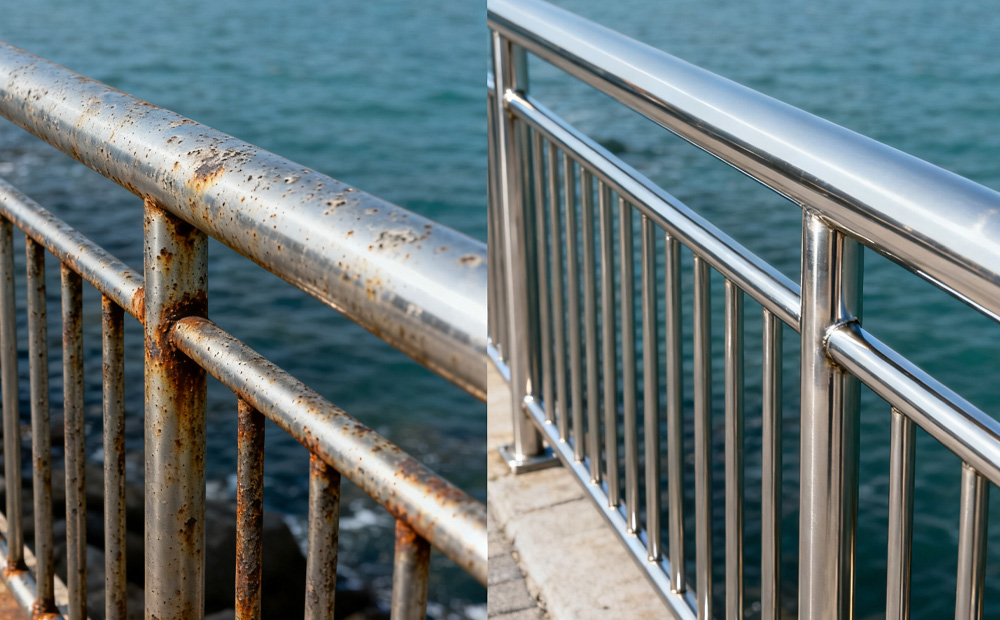
Both grades contain chromium and nickel, but 316L also contains approximately 2–3% molybdenum. Molybdenum improves resistance to chloride-related pitting and staining caused by sea air, salt deposits and certain industrial environments.
The letter “L” means low carbon. The reduced carbon content helps limit corrosion risks around welded areas, which is important for large sculptures made from many welded stainless steel panels. In practical terms, 304 is an economical general-purpose grade, while 316L provides better performance in salt-exposed, humid and heavily welded applications.
For dry indoor spaces such as hotel lobbies, galleries, shopping malls, offices and private residences, 304 or 304L is normally sufficient. It may also be suitable for inland parks and plazas where chloride exposure and industrial pollution are low.
For coastal sites, 316L is generally preferred because salt in the air can collect on the sculpture and damage the protective surface film. It is also a better starting choice for humid cities, locations exposed to deicing salt and many industrial environments.
Swimming pools, spas and areas exposed to chlorinated water may require 316L or a higher-grade stainless steel. Direct marine splash zones and extremely saline environments may require 2205 duplex stainless steel or another higher alloy.
These recommendations are starting points. The final grade should be selected according to the actual exposure, finish and maintenance conditions.
Chloride particles can collect around welds, narrow joints, horizontal surfaces, sheltered areas and drainage points. These deposits may cause tea staining, pitting or crevice corrosion.
The molybdenum in 316L improves resistance to this type of localized attack. However, distance from the sea is not the only factor. Wind direction, rainfall, humidity, temperature, surface orientation and cleaning frequency also affect corrosion risk.
A sculpture several kilometres from the coast may still receive heavy salt deposits when it faces strong coastal winds. A sculpture closer to the sea may perform better when it receives regular rain washing and has a smooth, properly treated surface. Coastal projects should therefore be evaluated according to real site conditions rather than a fixed distance rule.
Large stainless steel sculptures usually require extensive welding. Welding heat may reduce corrosion resistance around the heat-affected area when the material and welding process are not properly controlled.
The lower carbon content of 316L helps reduce this risk, making it suitable for sculptures with many welded panels and internal reinforcing parts. For the same reason, 304L may be preferred to standard 304 for heavily welded projects.
The grade alone is not enough. Weld discoloration and heat tint should be removed according to the required finish, and the treated areas may need grinding, pickling, passivation or electropolishing.
Even 316L can develop rust stains when fabrication quality is poor. Stainless steel should not be contaminated by carbon-steel grinding dust, ordinary steel wire brushes or tools previously used on mild steel. Embedded iron particles may later oxidize and appear as rust spots.
The sculpture should also avoid narrow crevices, water traps, rough welds and sealed cavities without drainage. Horizontal surfaces and sheltered undersides often retain salt and moisture longer than open vertical areas.
A smooth surface is easier to clean, but mirror polishing alone does not guarantee corrosion resistance. Correct material selection, clean fabrication, suitable welding, proper drainage and regular maintenance must work together.
Yes. 304 and 304L can perform well in mild inland environments, rural areas and locations with low chloride exposure. Suitable finishing, treated welds, good drainage and maintenance access are still required.
The correct question is not simply whether the sculpture is outdoors. The project team should consider what salt, pollution, moisture, heat and cleaning conditions the sculpture will experience.
A correctly fabricated 304L sculpture in a mild inland site may perform better than a poorly fabricated 316L sculpture.
No stainless steel is completely rustproof in every environment. 316L may still develop staining or localized corrosion when salt deposits are heavy, weld contamination remains, the surface is rough, narrow gaps trap water or cleaning is neglected.
Sheltered areas can sometimes be more vulnerable because rain cannot wash away salt and pollution. Coastal sculptures may require periodic washing with clean water, especially around joints, undersides and horizontal surfaces.
For direct marine splash, aggressive chemicals or highly chlorinated environments, a higher alloy may be necessary.
Not every component must always use the same grade, but mixed-material construction must be properly designed. The visible exterior skin may use 304L for a mild inland project and 316L for a coastal project. Internal framing may use stainless steel or appropriately protected structural steel depending on condensation, drainage, accessibility and project requirements.
Base plates, anchors and bolts require special attention because they are often exposed to trapped water. Compatible stainless steel fasteners should be used where future disassembly or maintenance is required.
Cost can also be reduced through efficient sheet thickness, optimized internal framing, detachable construction, workshop trial assembly and container-loading planning. Better engineering often saves more than simply reducing the stainless steel grade.
For important projects, the contract should specify the required grade and applicable standard. Buyers should request a Mill Test Certificate showing the grade, heat number, chemical composition, mechanical properties and material thickness.
A handheld XRF analyzer can identify chromium, nickel and molybdenum, making it useful for distinguishing 304-type material from 316-type material. However, XRF cannot accurately confirm the low carbon content that separates 316 from 316L.
To verify the “L” grade, OES, suitable LIBS equipment or laboratory carbon analysis may be required. Chemical identification liquids may be used for preliminary screening but should not replace material certificates and professional testing.
Service life cannot be determined from the material grade alone. It also depends on plate thickness, internal structure, welding quality, surface finish, drainage, fasteners, pollution, salt exposure and maintenance.
A properly designed and fabricated stainless steel sculpture can provide a long service life, but a fixed number of years should not be promised without reviewing the actual site conditions.
Choose 304 or 304L for indoor projects and mild inland environments where chloride exposure is low, drainage is good and maintenance access is available.
Choose 316L for coastal locations, humid or polluted environments, sites exposed to salt or deicing chemicals and sculptures involving extensive welding.
Consider 2205 duplex or another higher grade for direct marine splash, highly saline conditions, chlorinated water, aggressive chemicals or projects where maintenance access is very limited.
The choice between 304 and 316L should be based on the environment, fabrication method, surface finish and maintenance plan. 304 and 304L remain suitable and economical for many indoor and mild outdoor sculptures. For coastal, humid, salt-exposed and heavily welded projects, 316L generally provides better corrosion resistance. Severe marine, pool or industrial environments may require a higher-grade material.
Before confirming the material, provide the fabricator with the project location, distance from saltwater, indoor or outdoor use, environmental exposure, required finish and maintenance expectations.
Jessie Artworks provides custom stainless steel sculptures, public art, commercial installations, art furniture and mixed-material art fabrication. Our services include material selection, structural planning, metal forming, welding, grinding, polishing, trial assembly, detachable structure design, export packing and overseas installation preparation.
Website: https://www.steelart-works.com
Email: jessie@steelart-works.com
Previous: No Results